
Have you ever searched for something on Google and wondered why some websites appear at the top while others are nowhere to be found? What is SEO, and how does it help websites rank higher? SEO, or Search Engine Optimization, helps websites become more visible in search engines so that people can find them when they search for relevant information, products, or services
SEO helps websites become more visible in search engines so that people can find them when they search for relevant information, products, or services.
In this guide, we’ll explain what is SEO, how it works, why it matters, and how beginners can start learning it.
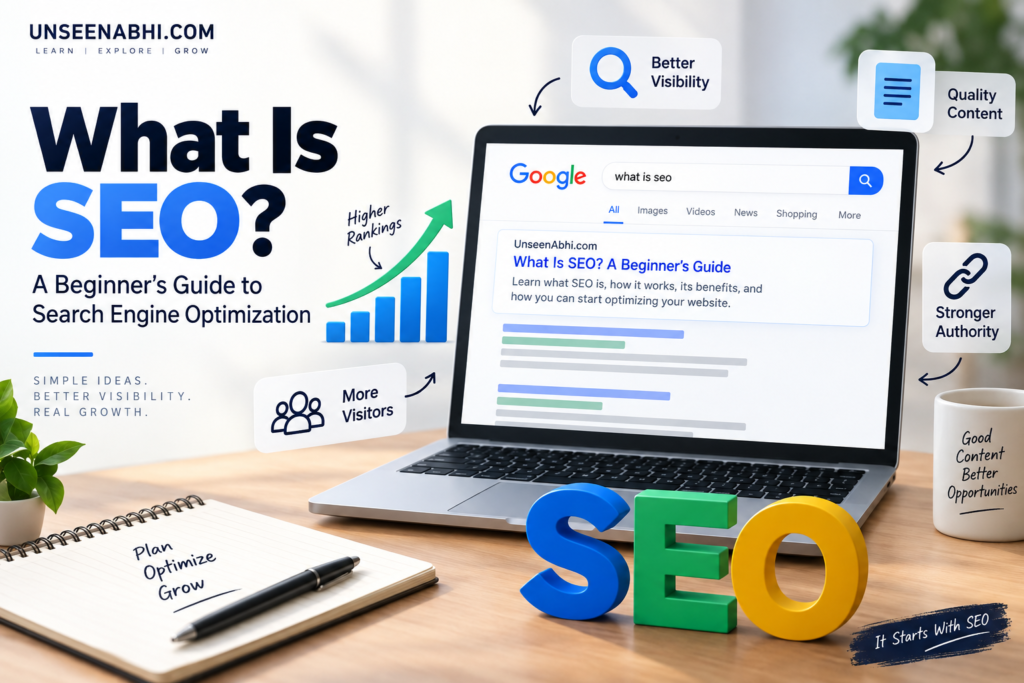
What Is SEO?
SEO (Search Engine Optimization) is the process of improving a website’s visibility in search engine results pages (SERPs) to attract relevant, unpaid traffic.
In simple words, SEO helps search engines understand your website and helps users find it.
For example, if you search for “best digital marketing course”, Google shows many results. Websites that have strong SEO may appear higher in the results, making them more likely to receive visitors.
What Does SEO Stand For?
- S: Search
- E: Engine
- O: Optimization
SEO is mainly about making a website easier for both search engines and users to understand.
How Does SEO Work?
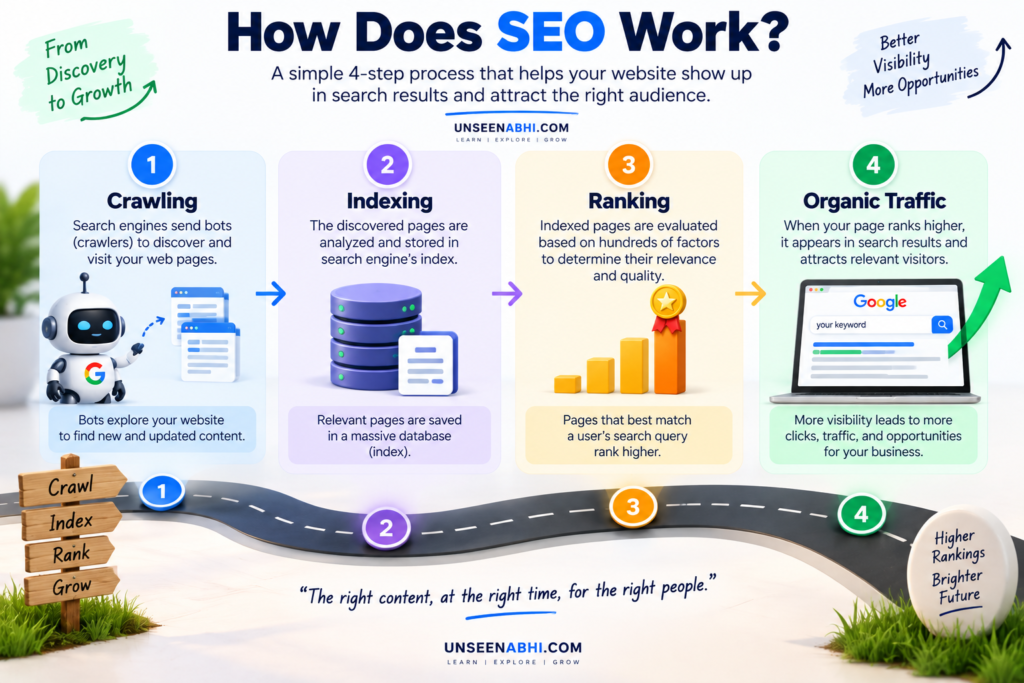
Search engines such as Google use automated programs called crawlers or bots to discover and understand web pages.
The basic process is:
Crawling → Indexing → Ranking → Organic Traffic
1. Crawling
Crawling is when search engine bots discover and visit web pages.
For example, Googlebot may visit your website and follow links to discover your blog posts.
2. Indexing
Indexing is when a search engine stores information about a page in its search index.
If a page is indexed, it may be eligible to appear in search results.
3. Ranking
Ranking is the process of deciding which pages appear for a particular search query and in what order.
Google considers many factors, including relevance, content quality, and technical aspects of a website.
4. Organic Traffic
Organic traffic is the traffic a website receives from unpaid search results.
For example, someone searches “what is SEO”, clicks your blog, and visits your website. That is organic traffic.
Why Is SEO Important?
SEO is important because it helps people discover your website without depending entirely on paid advertising.
1. Increases Website Visibility
Good SEO can help your pages appear for relevant searches.
2. Brings Relevant Visitors
SEO focuses on attracting people who are already searching for information related to your content.
3. Builds Trust and Credibility
Websites that consistently provide useful, accurate, and trustworthy content can build credibility with users.
4. Supports Long-Term Growth
Unlike an advertisement that stops running when its budget ends, a useful page can continue attracting organic traffic over time.
However, SEO is not guaranteed to produce rankings or traffic.
What Are the Main Types of SEO?
SEO is commonly divided into three main areas:
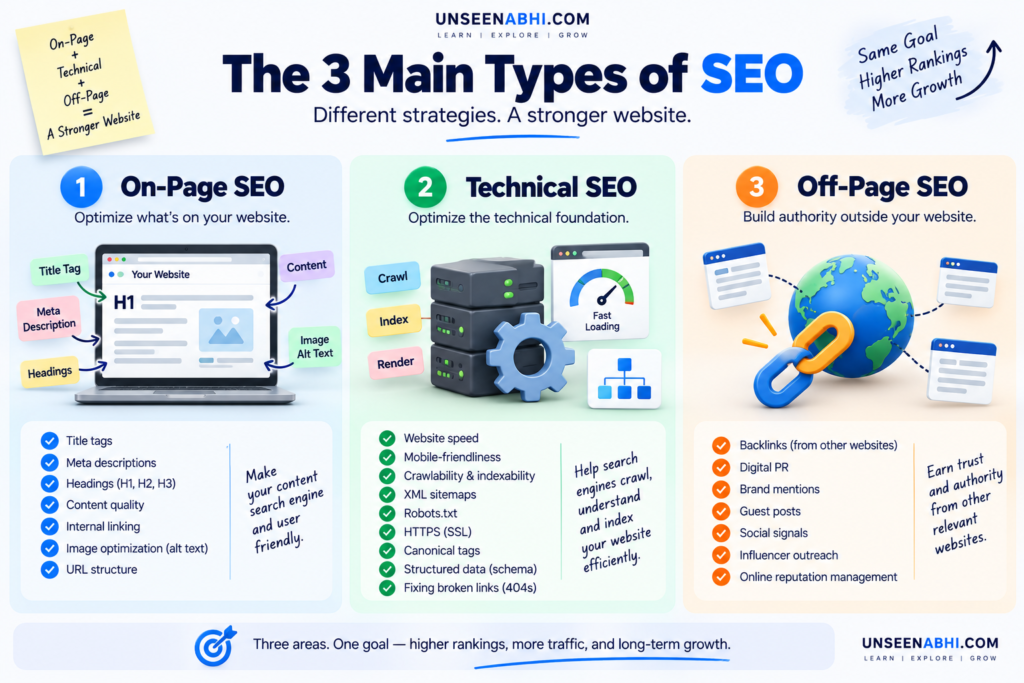
1. On-Page SEO
On-page SEO involves optimizing elements on your website.
Examples include:
- Keyword research
- Title tags
- Meta descriptions
- Headings
- Content quality
- Internal linking
- Image SEO
- URL optimization
Example: If you write a blog about SEO, using a clear title such as “What Is SEO? A Beginner’s Guide” helps users and search engines understand the topic.
2. Technical SEO
Technical SEO focuses on improving the technical aspects of a website so that search engines can crawl, understand, and access its pages.
Examples include:
- Website speed
- Mobile-friendliness
- Crawlability
- Indexability
- XML sitemaps
- Robots.txt
- HTTPS
- Canonical tags
- Structured data
Example: If important pages are blocked from crawling, search engines may have difficulty discovering them.
3. Off-Page SEO
Off-page SEO involves activities outside your website that can help build its reputation and visibility.
Examples include:
- Backlinks
- Digital PR
- Brand mentions
- Relevant online partnerships
Example: If another reputable website links to your useful article, that link may help search engines understand that your content is valuable.
What Is Keyword Research?
Keyword research is the process of finding the words and phrases people use when searching online.
For example, if you want to write about SEO, possible keywords include:
- What is SEO
- SEO for beginners
- How does SEO work
- Types of SEO
- SEO benefits
Keyword research helps you understand what your audience wants to know.
What Is Keyword Search Volume?
Search volume refers to the estimated number of times a keyword is searched during a specific period.
For example, a keyword with higher search volume may have more potential traffic, but it may also be more competitive.
What Is Keyword Difficulty?
Keyword difficulty is an estimate of how difficult it may be to rank for a keyword.
A beginner may find it easier to target specific, less competitive keywords rather than only broad keywords.
What Is Keyword Density?
Keyword density refers to how frequently a keyword appears in a piece of content.
For example, if a 500-word article contains a keyword 5 times:
Keyword density = 5 ÷ 500 × 100 = 1%
However, there is no ideal keyword density that guarantees rankings.
The goal is to use keywords naturally and avoid keyword stuffing.
What Is Keyword Proximity?
Keyword proximity refers to how close related words are to each other in a sentence or piece of content.
For example:
Less natural:
“SEO is useful. Beginners can learn it.”
More direct:
“SEO for beginners is a useful skill to learn.”
The second example keeps the important words closer together, but proximity should never come at the expense of natural writing.
What Is a Title Tag?
A title tag is the HTML title of a web page. Search engines may use it as the clickable title shown in search results.
For example:
What Is SEO? A Beginner’s Guide | Unseen Abhi
A good title should be clear, relevant, and written for users.
What Is a Meta Description?
A meta description is a short summary of a web page.
It may appear below the title in search results, although Google can choose a different snippet.
Example:
Learn what SEO is, how search engines work, the main types of SEO, and how beginners can start optimizing a website.
A useful meta description can help users understand what your page offers.
What Are Internal Links?
Internal links are links that connect one page of your website to another page on the same website.
Internal links help users discover related content and help search engines understand the structure of your website.
What Are Backlinks?
Backlinks are links from one website to another website.
For example, if another website links to your SEO guide, that is a backlink to your website.
Relevant, high-quality backlinks can help support a website’s authority and visibility.
However, buying spammy backlinks or creating links only to manipulate rankings can harm your SEO.
What Is Image SEO?
Image SEO is the process of optimizing images so they are useful for users and easier for search engines to understand.
Important practices include:
- Using descriptive file names
- Writing useful alt text
- Compressing images
- Choosing appropriate image dimensions
- Using suitable image formats
For example, instead of:
IMG_1234.jpg
You could use:
seo-beginner-guide.jpg
What Is Technical SEO?
Technical SEO focuses on the technical health of a website.
For example, a website may have excellent content, but if important pages cannot be crawled or indexed, they may not appear in search results.
Technical SEO helps ensure that search engines can access and understand the website properly.
What Is Local SEO?
Local SEO helps businesses appear in search results for location-based searches.
For example:
“Best digital marketing agency in Delhi”
Local SEO may involve:
- Google Business Profile
- Local business information
- Reviews
- Location-specific content
- Consistent business details
What Is SEO vs SEM?
SEO focuses on improving organic search visibility.
SEM is a broader term often used for search engine marketing, including paid search advertising and, depending on the context, SEO.
For example:
- SEO: Improving a blog to attract unpaid Google traffic.
- Paid search: Running Google Ads to appear in sponsored search results.
Is SEO Free?
SEO does not require paying Google to rank organically.
However, SEO may involve costs such as:
- SEO tools
- Content creation
- Website development
- Technical improvements
- Hiring an SEO professional
You can also learn and practice many SEO techniques for free.
How Long Does SEO Take to Work?
SEO usually takes time.
Some changes may show results relatively quickly, while others may take months.
The timeline depends on factors such as:
- Website competition
- Content quality
- Website authority
- Technical issues
- Search demand
- Consistency
SEO is a long-term process, not an instant solution.
How Can Beginners Start Learning SEO?
If you are new to SEO, start with these steps:
Step 1: Learn the Basics
Understand crawling, indexing, ranking, keywords, and the main types of SEO.
Step 2: Practice Keyword Research
Find keywords related to a topic and understand what users are searching for.
Step 3: Write Useful Content
Create content that answers real questions and provides value.
Step 4: Learn On-Page SEO
Practice optimizing titles, headings, URLs, images, and internal links.
Step 5: Learn Technical SEO
Understand how websites are crawled, indexed, and structured.
Step 6: Learn Off-Page SEO
Understand backlinks, digital PR, and how websites build authority.
Step 7: Measure Results
Use tools such as Google Search Console and Google Analytics to understand website performance.
Frequently Asked Questions
What is SEO in simple words?
SEO is the process of improving a website so that search engines can understand it and users can find it more easily.
What are the 3 main types of SEO?
The three main types are on-page SEO, technical SEO, and off-page SEO.
Is SEO important for a website?
Yes. SEO can help a website attract relevant organic traffic and improve its visibility in search engines.
Can I learn SEO without coding?
Yes. You can learn many SEO skills without coding. However, basic technical knowledge can be useful, especially for technical SEO.
Is SEO a good career?
SEO can be a useful career skill for people interested in digital marketing, content, websites, and analytics.
Conclusion
SEO is an important part of digital marketing that helps websites become more visible in search engines.
By learning on-page SEO, technical SEO, off-page SEO, keyword research, and content optimization, beginners can build a strong foundation in SEO.
The best way to learn SEO is to understand the concepts and practice them on a real website.
Want to learn more? Explore our other SEO guides on unseenabhi.com.
Pingback: Generative Engine Optimization (GEO): A New Way to Search - unseenabhi.com
Pingback: Is SEO Dead With AI? The Future of SEO in 2026 - unseenabhi.com