
Generative Engine Optimization (GEO) is changing the way businesses think about search visibility. For years, people relied mainly on traditional search engines to find information.
This shift is changing how content is created, optimized, and discovered. But what exactly does GEO mean, how is it different from traditional SEO, and what can businesses do to prepare for AI-powered search?
In this guide, we’ll explore how search is evolving, how Generative Engine Optimization fits into this changing landscape, and practical ways businesses can make their content more useful for both people and modern search experiences.
.
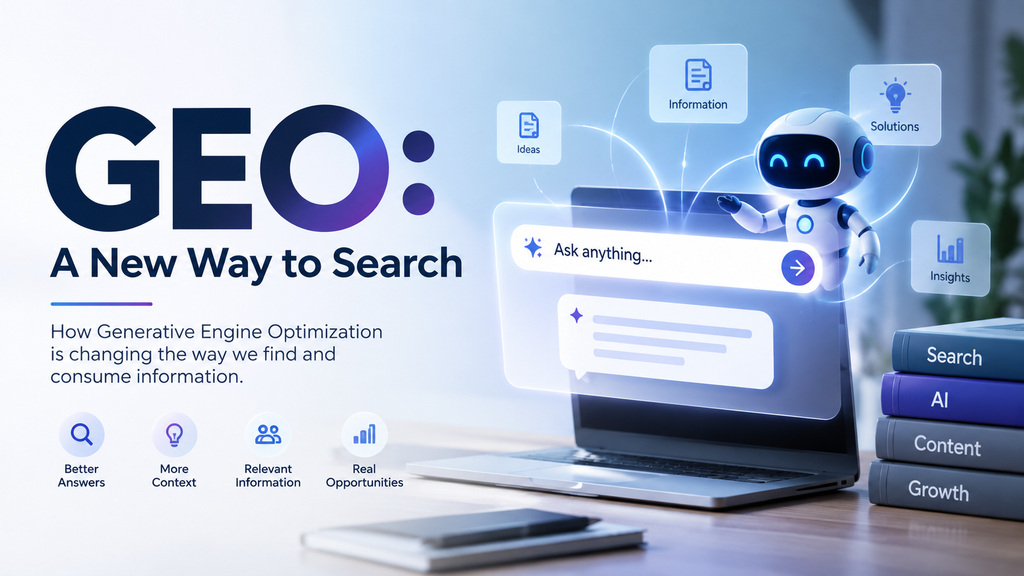
For years, search meant typing a few keywords into Google and choosing from a list of websites. Today, people can ask AI-powered platforms complete questions and receive direct, conversational answers.
This shift has introduced a new concept in digital marketing and search: Generative Engine Optimization (GEO).
Instead of focusing only on where a webpage appears in traditional search results, GEO considers how content can be understood and potentially surfaced within AI-powered search experiences.
But what does this mean for websites, businesses, and content creators?
Let’s explore how search is changing, what GEO means, how it relates to SEO, and what businesses can do to prepare for the next generation of search.
What Is GEO?
Generative Engine Optimization (GEO) is the practice of creating and structuring content so that AI-powered search and answer engines can better understand, interpret, and potentially reference that information when generating responses.
Traditional SEO focuses largely on improving a website’s visibility in search engine results pages.
AI-powered search can work differently.
Instead of simply displaying a list of links, an AI system may interpret a user’s question, gather relevant information, and generate a summarized response.
For example, instead of searching:
“Best SEO tools”
a user might ask:
“Which free SEO tools can I use to perform a technical SEO audit on my website?”
The second query provides more context and describes a specific problem.
An AI-powered search experience can use information from different sources to help answer that question.
This creates a new opportunity for websites that provide clear, useful, accurate, and trustworthy information.
Why Is Search Changing?
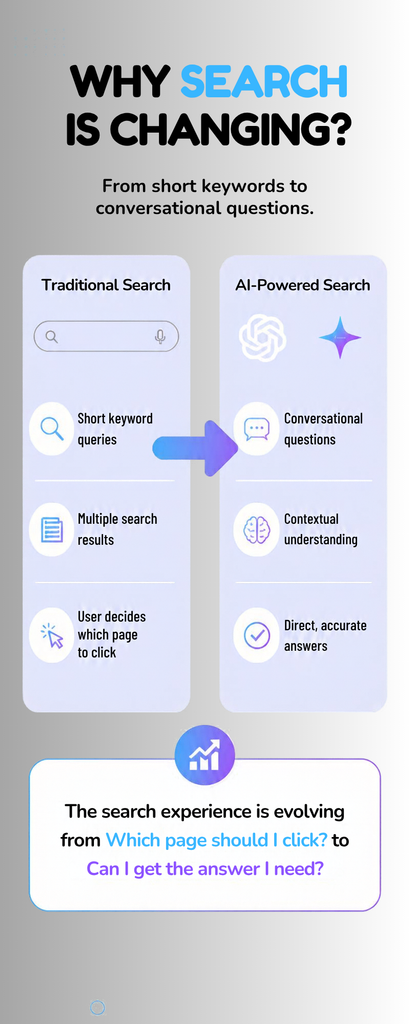
Search behavior has evolved significantly over the years.
In the early days of search, users often entered simple keywords.
For example:
“SEO”
Today, a user can ask:
“How can I improve the technical SEO of a small business website?”
The difference is important.
The second query communicates:
- The subject
- The user’s goal
- The type of information they need
- Additional context
AI-powered search is designed to handle these more conversational queries.
This doesn’t mean traditional search is disappearing. Search engine optimization continue to be an important way for people to discover websites, products, services, and information.
Instead, we’re moving toward a search environment where users have more ways to find and consume information.
Traditional SEO vs GEO
SEO and GEO are closely connected, but they aren’t exactly the same.
| Traditional SEO | GEO |
|---|---|
| Focuses on visibility in search results | Focuses on visibility within AI-generated answers |
| Keywords are an important research tool | Questions, topics, and entities become increasingly important |
| Rankings are a major performance indicator | Mentions, citations, and referrals can provide additional signals |
| Optimizes webpages for search engines | Focuses on making information easier for AI systems to understand |
| Technical SEO is important | Technical SEO remains important |
The important thing to understand is that GEO doesn’t replace SEO.
A website still needs to be accessible, crawlable, indexable, technically sound, and useful.
Instead, GEO can be viewed as an additional consideration as search becomes more conversational and AI-driven.
How Does GEO Work?
There isn’t a single formula that guarantees visibility in AI-generated answers.
Different platforms use different technologies and systems, and their methods can change over time.
However, the basic principle is straightforward:
Create information that clearly answers people’s questions and provides genuine value.
This means focusing on things such as:
- Search intent
- Content quality
- Clear structure
- Accurate information
- First-hand experience
- Relevant sources
- Topical depth
- Internal linking
- Technical SEO
The objective shouldn’t be to manipulate AI systems.
It should be to make your website a useful and trustworthy source of information.
8 Ways to Prepare Your Content for AI-Powered Search
1. Understand What Your Audience Wants
Before creating an article, don’t start with keywords alone.
Start with the question:
What problem is the user trying to solve?
For example, someone searching for:
“SEO audit”
could have several different needs.
They might want to:
- Learn what an SEO audit is
- Find an SEO audit checklist
- Audit their own website
- Hire an SEO professional
- Find an SEO audit tool
Understanding the intent behind the search helps you create content that actually satisfies the user.
2. Answer Questions Clearly
If your content answers a specific question, provide the answer directly.
For example:
What Is Keyword Research?
Keyword research is the process of finding and analyzing the terms people use when searching for information, products, or services online.
You can then explain the process in greater detail.
This approach helps readers quickly find the information they need without sacrificing depth.
3. Organize Information Clearly
A well-structured article is easier for people to read and easier to understand.
Use:
- Clear headings
- Short paragraphs
- Bullet points
- Numbered lists
- Tables
- Examples
- FAQs
For example:
Technical SEO
What Is Technical SEO?
Why Is Technical SEO Important?
Technical SEO Checklist
This creates a logical relationship between the main topic and supporting information.
4. Go Beyond Generic Information
Simply rewriting information that already exists online doesn’t necessarily make an article valuable.
Try to add something useful that comes from your own experience or research.
This could include:
- Original examples
- Case studies
- Screenshots
- Research
- Data
- Practical workflows
- Expert observations
- Before-and-after comparisons
For example, instead of explaining what a website audit is, you could publish an actual audit showing the problems you discovered and how you would fix them.
5. Use Reliable Sources
When making important factual claims, statistics, or research-based statements, use reliable sources.
Depending on your topic, these could include:
- Official documentation
- Government websites
- Academic research
- Industry organizations
- Original research
- Established publications
Sources allow readers to verify important information and help distinguish evidence from opinion.
6. Build Topic Depth
A website shouldn’t have dozens of unrelated articles.
Instead, create connected resources around topics that matter to your audience.
For example, a website focused on SEO could have content covering:
- Keyword research
- On-page SEO
- Technical SEO
- Off-page SEO
- Internal linking
- Schema markup
- Core Web Vitals
- SEO audits
- Local SEO
- Keyword cannibalization
Where appropriate, link these articles together.
This creates a stronger information structure and helps users discover related resources.
7. Keep Your Information Updated
Technology and search are constantly evolving.
An article that was accurate two years ago may contain outdated information today.
Review important pages periodically and update:
- Statistics
- Examples
- Tools
- Links
- Screenshots
- Recommendations
- Industry developments
Don’t update an article simply to change its publication date. Make meaningful improvements that increase its usefulness.
8. Maintain Strong Technical SEO
AI search doesn’t make technical SEO irrelevant.
Your website still needs a solid technical foundation.
Important areas include:
- Crawlability
- Indexability
- XML sitemaps
- Robots.txt
- Canonical tags
- Internal linking
- Mobile usability
- Page performance
- Core Web Vitals
- HTTPS
- Structured data
- URL structure
High-quality content is most useful when search systems can properly access and understand your website.
How GEO Changes Content Strategy
The rise of AI-powered search changes the way marketers should think about content.
Previously, the focus was often:
What keyword should I rank for?
A broader question is now:
What information does my audience actually need?
This doesn’t mean keywords are no longer useful.
Keyword research still helps marketers understand language, demand, and search behavior.
But keywords should be treated as signals of user needs, rather than phrases that need to be repeated throughout an article.
For example, if you’re creating content about technical SEO, don’t force the phrase “technical SEO” into every paragraph.
Instead, naturally cover related concepts such as:
- Crawling
- Indexing
- Site architecture
- XML sitemaps
- Robots.txt
- Canonical URLs
- Page performance
This creates a more complete resource without making the writing unnatural.
Can GEO Replace SEO?
No.
Traditional SEO remains an important part of website visibility.
Search engines still need to discover, crawl, index, and understand websites.
Technical SEO, content quality, internal linking, website architecture, and other established practices continue to matter.
GEO is better understood as an additional layer of modern search optimization.
A strong strategy can combine:
Technical SEO + Quality Content + Search Intent + Topical Authority + AI Search Optimization
The goal isn’t to abandon traditional SEO.
It’s to adapt to the different ways people now discover information.
How Can You Measure GEO?
Measuring visibility in AI-powered search can be more difficult than tracking traditional search rankings.
With traditional SEO, marketers commonly monitor:
- Keyword rankings
- Organic traffic
- Impressions
- Click-through rate
- Backlinks
- Conversions
For AI-powered search, businesses can also look at:
- Brand mentions
- Citations or links
- Referral traffic
- Branded searches
- Leads
- Conversions
- Visibility for important questions
You can also manually test relevant questions across different AI search platforms and record whether your website or brand appears.
However, AI-generated results can vary based on the platform, query, location, personalization, and time.
Common Mistakes to Avoid
Keyword Stuffing
Repeating the same phrase excessively can make content difficult to read.
Use your primary topic naturally and allow related terminology to appear where it makes sense.
Creating Content Only for AI
Your content should be useful to humans first.
If readers find an article confusing, repetitive, or unhelpful, optimizing it specifically for AI won’t fix the underlying problem.
Publishing Generic Content
Simply rewriting existing articles doesn’t necessarily provide additional value.
Add original examples, research, experience, or useful explanations whenever possible.
Making Unsupported Claims
The technology behind AI search is evolving quickly.
Avoid presenting assumptions about how individual AI systems work as guaranteed facts.
Ignoring Technical SEO
Great content can still struggle if search engines cannot properly access, crawl, or index your website.
Frequently Asked Questions
What Does GEO Stand For?
GEO stands for Generative Engine Optimization. It refers to practices aimed at making online content easier for AI-powered search systems to understand and potentially use in generated responses.
Is GEO the Same as SEO?
No. SEO focuses primarily on improving visibility in traditional search results, while GEO considers visibility within generative search experiences. The two overlap and can work together.
How Can I Optimize My Website for AI Search?
Start with the fundamentals: understand your audience, satisfy search intent, create useful content, organize information clearly, demonstrate experience, support important claims with reliable sources, and maintain good technical SEO.
Can GEO Guarantee AI Citations?
No. There is no guaranteed technique that will make a website appear in an AI-generated answer. Results can vary between platforms and queries.
Is GEO Important for Small Businesses?
It can be. Small businesses can create highly useful content around the specific questions and problems their customers have. Original knowledge and relevant information can help a business establish a stronger online presence.
The Future of Search
GEO isn’t about replacing everything we know about SEO.
It’s about recognizing that search is becoming more conversational, contextual, and answer-focused.
People can now ask complex questions and expect useful information without necessarily visiting multiple websites.
For businesses, this makes the quality of their online information more important than ever.
The strongest approach isn’t to chase every new AI platform or constantly repeat a target keyword.
Instead, focus on the fundamentals:
Understand your audience. Answer their questions. Provide useful information. Demonstrate genuine expertise. Keep your content accurate. Build a technically healthy website.
As search continues to evolve, the websites that consistently help people find reliable answers will have a stronger foundation for visibility across different search experiences.
Conclusion
GEO represents a new direction in the way we think about search visibility.
Traditional SEO helped businesses optimize websites for search engines. The rise of generative search adds another consideration: how effectively can that information be understood and used within AI-powered answers?
There is no guaranteed shortcut.
The most sustainable approach is to create content that is useful, accurate, trustworthy, well-structured, and genuinely relevant to the people you’re trying to reach.
That is what makes GEO more than just another digital marketing acronym.
It represents a shift from simply optimizing for search results to creating information that can become part of the answer.
Search is changing.
For years, businesses focused on getting their websites to appear higher in Google’s traditional search results. Keyword research, backlinks, technical SEO, and on-page optimization became essential parts of digital marketing.
Today, people are also using AI-powered tools such as ChatGPT, Google AI Overviews, Microsoft Copilot, and Perplexity to find information and get answers.
Instead of clicking through several search results, a user can ask a detailed question and receive a summarized response.
This change has introduced a growing area of search marketing: Generative Engine Optimization (GEO).
But GEO isn’t simply about adding more keywords to a webpage or trying to “hack” an AI system. The fundamental idea is much simpler: create useful, trustworthy, well-structured information that AI-powered search systems can understand and users can rely on.
In this guide, we’ll explore what GEO means, how it differs from traditional SEO, and the practical steps businesses can take to prepare their content for AI-powered search.
Pingback: Is SEO Dead With AI? The Future of SEO in 2026 - unseenabhi.com