is SEO dead with AI? Artificial intelligence is changing the way people search for information. Instead of always relying on traditional search engines, users can now ask AI tools detailed questions and receive conversational answers within seconds.
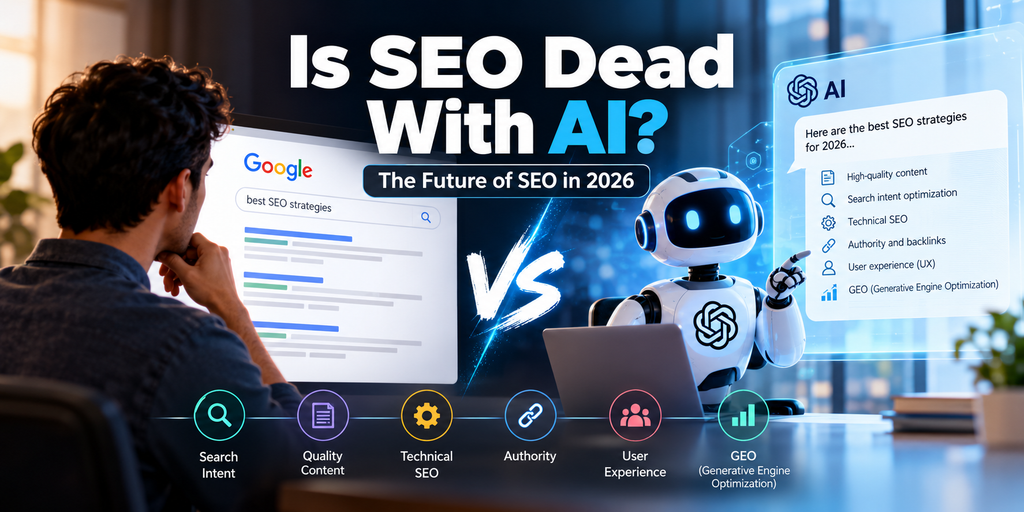
SEO is evolving alongside AI-powered search. Traditional rankings still matter, but modern SEO now involves search intent, helpful content, technical optimization, authority, user experience, and emerging strategies such as GEO (Generative Engine Optimization).
The real question isn’t whether SEO will disappear, but how SEO will adapt to the changing search landscape.
Why Are People Asking This?
The rise of AI-powered search has changed the way people discover information.
Previously, a typical search journey looked something like this:
- Search for a question on Google.
- Browse the search results.
- Open several websites.
- Compare the information.
- Find an answer.
AI-powered search can sometimes provide a summarized answer directly.
This creates an obvious concern for website owners:
If AI can answer the question, why would users visit a website?
The concern is understandable, but it doesn’t mean websites have become irrelevant.
People still search for products, services, businesses, reviews, comparisons, tutorials, original research, and detailed solutions.
The bigger change is that search visibility is expanding beyond traditional search rankings.
Is Traditional SEO Still Relevant?
Yes.
Search engines still need to discover, crawl, understand, and evaluate webpages.
Websites still need:
- Useful and relevant content
- Strong technical foundations
- Logical site structure
- Internal links
- Authoritative references
- Good user experience
- Content that satisfies search intent
However, modern SEO is no longer simply about placing a keyword on a webpage.
Consider a person searching for:
“Best digital marketing agency in Chandigarh.”
They may not simply want a list of agencies.
They could be looking for:
- Services offered
- Pricing
- Experience
- Client results
- Reviews
- Case studies
- Contact information
This is where search intent becomes important.
SEO professionals need to understand the reason behind a search rather than focusing only on the exact words used in the search box.
You can internally link this section to your detailed search intent article.
SEO Is Moving Beyond Keywords
Keywords are still important, but they are no longer the entire SEO strategy.
Search engines have become better at understanding context, relationships between topics, and what users are actually looking for.
For example, someone searching for “running shoes” may also expect information about:
- Different types of running shoes
- Cushioning
- Shoe size
- Running surfaces
- Price
- Reviews
- Durability
- Where to buy
A page that repeats the phrase “running shoes” dozens of times without providing useful information isn’t necessarily a good result.
Modern SEO focuses on relevance, context, and search intent rather than keyword repetition.
How Is AI Changing SEO?
AI is changing both the search experience and the work SEO professionals do.
Users can now ask longer and more conversational questions instead of relying on short keywords.
For example, instead of searching:
“SEO benefits”
a user might ask:
“How can SEO help a small business get customers without spending heavily on paid advertising?”
The second query provides much more context.
This means content needs to answer real questions and solve real problems.
AI is also changing how marketers work.
SEO professionals can use AI to assist with:
- Topic research
- Content outlines
- Content gap analysis
- Keyword clustering
- Data analysis
- Brainstorming
- Content optimization
However, AI should be treated as a tool rather than a replacement for research, experience, and human judgment.
What Is GEO and How Does It Relate to SEO?
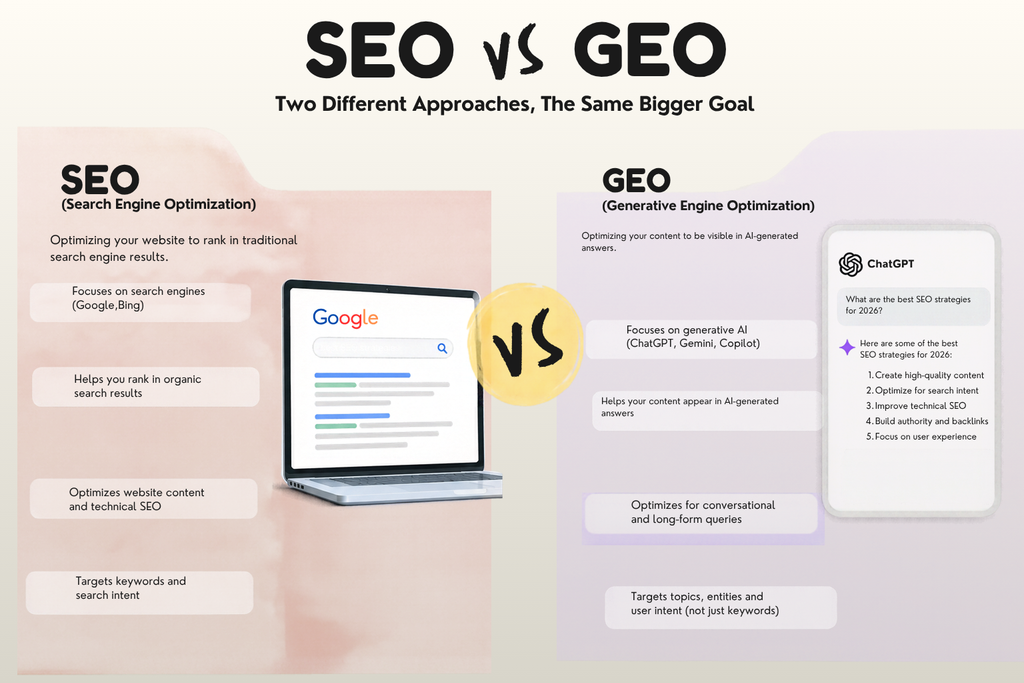
The growth of AI search has also introduced GEO, or Generative Engine Optimization.
GEO focuses on improving the visibility and representation of information within generative AI experiences.
Traditional SEO often asks:
“How can I improve my website’s visibility in search results?”
GEO adds another question:
“How can my information become useful and visible within AI-generated answers?”
SEO and GEO aren’t necessarily replacements for each other.
Strong SEO fundamentals can support a website’s overall discoverability, while GEO focuses specifically on emerging generative search experiences.
For example, clear content, strong topical relevance, authoritative information, useful structure, and trustworthy signals can all contribute to a stronger digital presence.
You can link this section to your previous article about GEO and how search is changing.
Will AI Replace Google Search?
AI is changing how search results can be presented, but traditional search remains important.
People continue to use search engines to:
- Find local businesses
- Research products
- Compare services
- Read reviews
- Find specific websites
- Learn about complex topics
- Make purchasing decisions
Consider an e-commerce search:
“Best laptop for graphic design under ₹80,000.”
An AI tool might explain which specifications matter, but the user may still want to visit product pages to:
- Compare specifications
- Check prices
- View images
- Read reviews
- Check availability
- Make a purchase
This means websites still play an important role in the customer journey.
Will AI Reduce Organic Traffic?
One of the biggest concerns behind is SEO dead with AI is the possibility of declining organic traffic.
The impact can vary depending on the type of search.
For simple informational searches, an AI-generated answer may satisfy the user without requiring a website visit.
For more complex searches, users may still need websites for detailed information or specific actions.
For example:
“What is a canonical tag?”
may require only a short explanation.
But:
“Which SEO agency should I hire for my e-commerce business?”
could require much more research.
A potential customer may want to compare:
- Services
- Pricing
- Experience
- Reviews
- Case studies
- Expertise
- Contact information
This is why SEO(search engine optimization) shouldn’t be measured only by the number of clicks.
For businesses, relevant visibility, qualified traffic, leads, and conversions also matter.
Quality Content Is Becoming More Important
AI can produce large amounts of content very quickly.
That doesn’t mean publishing more content automatically produces better SEO results.
If thousands of websites can generate similar articles, generic content becomes easier to create and harder to differentiate.
This creates an opportunity for websites that provide something genuinely useful.
Strong content can include:
- Original insights
- First-hand experience
- Practical examples
- Original research
- Expert explanations
- Relevant data
- Unique perspectives
- Clear solutions
Instead of asking:
“How many blogs can I publish?”
ask:
“What useful information can my website provide that deserves to be discovered?”
That shift is becoming increasingly important in modern SEO.
Does AI-Generated Content Hurt SEO?
Using AI during content creation does not automatically make content ineffective.
AI can help with:
- Brainstorming topics
- Creating outlines
- Organizing ideas
- Improving readability
- Identifying content gaps
- Generating initial drafts
However, publishing AI-generated content without reviewing it can create problems.
AI-generated content can contain:
- Incorrect information
- Outdated information
- Generic explanations
- Repetitive ideas
- Unsupported claims
Human review remains important.
The goal shouldn’t be to publish as much AI content as possible.
The goal should be to use AI as a tool while maintaining accuracy, originality, relevance, and usefulness.
Technical SEO Still Matters in the Age of AI
If you’re wondering is SEO dead with AI, technical SEO is one reason the answer remains no.
AI doesn’t eliminate the need for a technically sound website.
Search engines still need to access, crawl, and understand webpages.
Important technical SEO areas include:
- Crawling and indexing
- XML sitemaps
- Canonical tags
- Site architecture
- Mobile usability
- Page speed
- HTTPS
- Structured data
- Redirects
- Broken links
- Core Web Vitals
Imagine publishing an excellent article but accidentally preventing search engines from indexing it.
The content may be valuable, but a technical problem can prevent it from being discovered.
You can internally link this section to your technical SEO article.
Why Internal Linking Still Matters
Internal linking is another SEO practice that remains valuable.
Imagine your website has articles about:
SEO → Keyword Research → Search Intent → On-Page SEO → Technical SEO → GEO
Connecting these articles with relevant internal links creates relationships between your pages.
For example, your search intent article can link to this article, while your GEO article can link back to this guide.
This creates a connected topic cluster rather than a collection of isolated blog posts.
Internal links can also help readers discover related information and navigate your website more easily.
What Skills Will SEO Professionals Need in 2026?
The SEO professional of the future will need a broader skill set than simply knowing how to add keywords to a webpage.
1. Keyword Research
Understanding what people search for and identifying relevant opportunities.
2. Search Intent
Understanding whether a user wants information, a product, a service, a comparison, or a specific website.
3. Technical SEO
Understanding crawling, indexing, site architecture, structured data, canonicalization, and technical website health.
4. Content Strategy
Planning useful content around topics, audiences, search intent, and business goals.
5. E-commerce SEO
Optimizing product pages, category pages, filters, and transactional content.
6. Local SEO
Helping businesses become visible for searches with local intent.
7. Data Analysis
Using tools such as Google Search Console and analytics platforms to understand organic performance.
8. AI Search and GEO
Understanding how AI-powered search experiences are changing information discovery and visibility.
9. Conversion Optimization
Understanding that traffic isn’t always the final objective.
For a business, the journey may look like:
Visibility → Traffic → Leads → Customers
This makes SEO increasingly connected with broader digital marketing.
SEO vs GEO: Do Businesses Need Both?
Businesses don’t necessarily need to choose between SEO and GEO.
They can work together.
A modern search visibility strategy can include:
Technical SEO + Search Intent + Quality Content + Authority + User Experience + GEO
SEO provides the foundation for website visibility.
GEO focuses on emerging generative search experiences.
Both are part of the broader shift in how people discover information online.
So, Is SEO Dead With AI?
No, SEO is not dead with AI.
But the old approach to SEO is changing.
Strategies based primarily on keyword repetition, low-quality backlinks, and thin content are not a sustainable approach to modern search.
SEO is becoming a broader discipline.
It involves understanding:
- What users want
- Why they search
- How search engines understand content
- How websites are structured
- How authority is built
- How AI changes information discovery
- How visitors become customers
AI isn’t necessarily the end of SEO.
It is another major stage in the evolution of search.
Conclusion
So, is SEO dead with AI?
No.
SEO is evolving with AI.
Search is becoming more conversational, contextual, and diverse. People can discover information through traditional search engines, AI-powered search experiences, social platforms, maps, marketplaces, and other digital channels.
This means SEO professionals need to adapt.
The future isn’t about choosing between SEO and AI.
It’s about understanding how people search and creating information that is useful, trustworthy, accessible, and easy to understand across different search experiences.
If you’re learning SEO today, don’t focus only on ranking keywords.
Learn technical SEO, search intent, content strategy, internal linking, e-commerce SEO, local SEO, data analysis, and GEO.
The search landscape will continue to change.
But the fundamental goal remains the same:
Help the right people discover the right information at the right time.