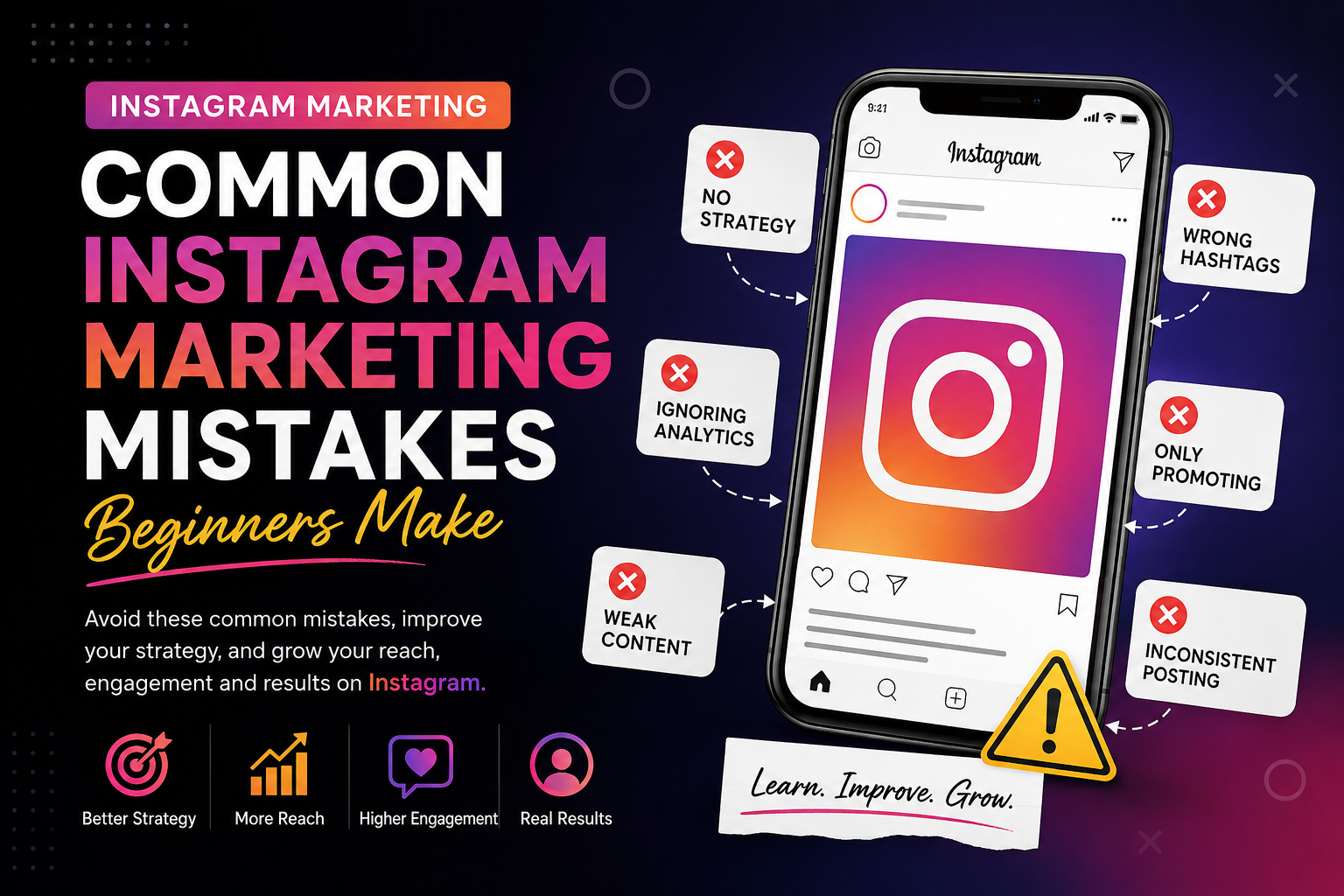
Common Instagram Marketing Mistakes Beginners Make
Instagram can be a powerful platform for building a personal brand, growing a business, generating leads, and connecting with potential customers.
But many beginners make the same mistakes when they start marketing on Instagram.
They post consistently but don’t get enough reach. They use dozens of hashtags but see little engagement. They copy viral content without understanding why it worked. Some even change their strategy every few days because they aren’t seeing immediate results.
The problem isn’t always the Instagram algorithm.
Often, it’s the strategy behind the content.
In this guide, we’ll look at the most common Instagram marketing mistakes beginners make and, more importantly, how you can avoid them.
1. Not Having a Clear Goal
One of the biggest Instagram marketing mistakes is starting to post without knowing what you’re trying to achieve.
Your goal could be:
- Building brand awareness
- Getting more followers
- Generating leads
- Increasing website traffic
- Selling products
- Building a personal brand
- Getting clients
- Creating an online community
If you don’t have a clear objective, your content can become random.
How to avoid it
Choose one primary goal for your Instagram account.
For example:
Goal: Get clients for social media management.
Your content can then focus on:
- Social media tips
- Instagram strategies
- Case studies
- Before-and-after examples
- Marketing mistakes
- Educational content
- Results and insights
A clear goal makes it much easier to decide what you should post.
2. Trying to Appeal to Everyone
Another common mistake is creating content for everyone.
Beginners often think:
“The more people I target, the more people will follow me.”
In reality, generic content can make it difficult for the right audience to understand why they should follow you.
How to avoid it
Define your target audience.
Ask yourself:
- Who am I creating content for?
- What problems do they have?
- What information are they looking for?
- What type of content would help them?
- What would make them follow me?
For example, instead of targeting “everyone interested in marketing,” you could target:
Small-business owners who want to use Instagram to generate customers.
That’s much more specific.
3. Posting Without a Content Strategy
Posting consistently is important, but consistency without strategy isn’t enough.
You could post every day and still struggle to grow if your content doesn’t provide value or connect with your audience.
How to avoid it
Create a few content pillars.
For example, a digital marketing account could use:
Educational:
Instagram tips, SEO, content strategy and marketing advice.
Problem-solving:
Common mistakes, low reach, poor engagement and content problems.
Authority:
Case studies, results, experiments and professional insights.
Personal:
Your experiences, lessons and journey.
Promotional:
Your services, portfolio and offers.
This creates variety while keeping your account focused.
4. Focusing Only on Followers
Many beginners believe that follower count is the most important Instagram metric.
It isn’t.
Having 10,000 followers doesn’t automatically mean you have a successful account.
You should also pay attention to:
- Reach
- Engagement
- Saves
- Shares
- Profile visits
- Website clicks
- DMs
- Leads
- Conversions
For a business account, 10 potential customers can be more valuable than 1,000 irrelevant followers.
How to avoid it
Don’t ask only:
“How many followers did I gain?”
Also ask:
“Did my content reach the right people?”
and:
“Did people take meaningful action?”
5. Ignoring the Instagram Profile
You can create excellent Reels, but if someone visits your profile and doesn’t understand what you do, you may lose a potential follower or customer.
Your profile should quickly communicate:
Who you are + what you offer + who you help + what the visitor should do next.
Optimize your profile
Make sure you have:
- A recognizable profile picture
- A clear name/name field
- A useful bio
- A relevant profile category
- A link when appropriate
- Strong pinned posts
- Consistent branding
Your pinned posts can introduce:
- Who you are
- What you do
- How you can help
6. Creating Content Only for Yourself
This is a subtle but important mistake.
Beginners often create content based entirely on what they personally want to post.
But effective marketing starts with the audience.
Instead of asking:
“What do I want to post today?”
Ask:
“What problem does my audience need help solving?”
Example
Weak approach:
“5 things I learned today.”
Better approach:
“5 Instagram lessons I wish I knew before starting.”
The second version is more focused on the audience.
7. Copying Competitors Without Understanding Why Their Content Works
Researching competitors is useful.
Copying them isn’t.
You may see a competitor getting millions of views and assume that copying their format will produce the same result.
But their success could depend on:
- Their audience
- Their reputation
- Their storytelling
- Their editing
- Their topic
- Their timing
- Their content history
How to avoid it
Study successful accounts for patterns, not exact copies.
Look at:
- Their hooks
- Topics
- Formats
- Storytelling
- Calls to action
- Comments
- Content structure
Then create your own version based on your audience.
8. Weak Hooks
On Instagram, people scroll quickly.
If the beginning of your Reel doesn’t give someone a reason to keep watching, they may move on.
A weak opening:
“Hey guys, today I’m going to talk about Instagram marketing.”
A stronger opening:
“If your Instagram Reels aren’t getting views, these 5 mistakes could be the reason.”
The second hook immediately identifies a problem.
How to improve your hooks
Use:
- A problem
- A surprising statement
- A specific result
- A question
- A curiosity gap
- A mistake
- A strong opinion
But don’t use misleading clickbait.
Your hook should accurately represent what the content delivers.
9. Making Every Post Promotional
If every post says:
“Buy my service.”
“Hire me.”
“DM me now.”
People can quickly lose interest.
Instagram marketing should not feel like a constant sales pitch.
Use the 3-part approach
Think about your content as:
Value → Trust → Conversion
First, help your audience.
Then demonstrate your expertise.
Then give interested people a way to work with you.
For example:
Educational Reel:
“3 Instagram mistakes killing your reach.”
Authority post:
“How I would improve this business’s Instagram strategy.”
Conversion post:
“I help small businesses build and manage their Instagram presence.”
10. Using Too Many Hashtags Without a Strategy
A common misconception is:
“More hashtags = more reach.”
Hashtags can help categorize content and improve discoverability, but they aren’t a replacement for good content.
Adding a large number of irrelevant hashtags won’t fix:
- A weak hook
- Poor content
- Low audience relevance
- Bad positioning
- Weak storytelling
How to use hashtags better
Choose hashtags that are genuinely relevant to:
- Your topic
- Your industry
- Your audience
- Your content
Also use relevant keywords naturally in your:
- Caption
- On-screen text
- Spoken content
- Profile
- Alt text where appropriate
Think about Instagram SEO, not just hashtags.
11. Ignoring Instagram SEO
Instagram isn’t only a social network. It’s also a discovery platform.
People can discover content through search, recommendations, profiles, and other surfaces.
If you want your content to be discoverable, make the topic clear.
For example, if your Reel is about Instagram marketing, don’t make the entire caption:
“You need to hear this 🔥”
Instead, naturally mention the subject:
“If you’re struggling with Instagram marketing, these three beginner mistakes could be hurting your growth…”
This gives Instagram more context about your content.
12. Posting for a Few Days and Giving Up
This is probably one of the biggest beginner mistakes.
Someone posts for five days.
Their Reels don’t perform.
They conclude:
“Instagram isn’t working for me.”
That’s too early.
Content performance can vary significantly from post to post.
Instead, treat Instagram like an experiment
Test:
- Different hooks
- Different topics
- Different formats
- Different video lengths
- Different storytelling styles
- Different calls to action
Then analyze the results.
Don’t judge your entire strategy based on one or two posts.
13. Changing Your Niche Every Week
One week you’re posting motivation.
The next week it’s fashion.
Then fitness.
Then memes.
Then digital marketing.
This can make it difficult to build a recognizable audience.
How to avoid it
You don’t necessarily need an extremely narrow niche.
But you should have a clear content direction.
For example, you can build a broader personal brand around:
Digital marketing + content creation + personal growth + your own journey.
The topics can vary while still making sense to the same audience.
14. Ignoring Comments and DMs
Instagram isn’t just a publishing platform.
It’s a social platform.
If someone takes the time to comment or send you a message, ignoring them means missing an opportunity to build a relationship.
What to do
- Respond to relevant comments.
- Answer genuine questions.
- Start conversations.
- Ask follow-up questions.
- Pay attention to recurring questions.
Your audience can actually tell you what content you should create next.
15. Not Studying Your Analytics
Posting without checking your analytics is like running a business without checking your sales.
You need to understand what’s working.
Depending on your account and available insights, look at metrics such as:
- Accounts reached
- Views
- Watch time
- Engagement
- Shares
- Saves
- Profile activity
- Follows
- Website visits
Ask better questions
Instead of:
“Why did this Reel flop?”
Ask:
“What was different about the Reels that performed better?”
Look for patterns.
If educational Reels consistently generate more saves, that’s a signal.
If certain topics generate more profile visits, that’s another signal.
Use the data to improve your next batch of content.
How to Avoid Instagram Marketing Mistakes
You don’t need a perfect Instagram strategy from day one.
Instead, follow a simple process:
Step 1: Define your audience
Know who you’re trying to reach.
Step 2: Set one primary goal
Decide what success means for your account.
Step 3: Create content pillars
Choose 3–5 topics you can consistently create content around.
Step 4: Create strong content
Focus on useful information, entertainment, education or storytelling.
Step 5: Optimize for discovery
Use clear topics, relevant keywords and appropriate hashtags.
Step 6: Engage with your audience
Treat Instagram as a community, not just a broadcasting platform.
Step 7: Analyze your results
Identify what’s working and what’s not.
Step 8: Improve and repeat
Don’t constantly restart. Make small improvements based on data.
Instagram Marketing Mistakes: Quick Checklist
Before publishing your next post, ask yourself:
- Is this content relevant to my target audience?
- Does the opening give people a reason to continue?
- Is the topic clear?
- Does the content provide genuine value?
- Is my caption useful rather than just promotional?
- Is my profile optimized?
- Am I using relevant keywords?
- Am I using relevant hashtags?
- Is there a clear purpose behind this post?
- Will I analyze the results afterward?
If you can answer “yes” to most of these, you’re already avoiding many of the mistakes beginners make.
Final Thoughts
Instagram marketing isn’t about finding one secret trick that suddenly makes your account go viral.
It’s about understanding your audience, creating valuable content, communicating your message clearly, and consistently learning from your results.
The biggest mistake beginners make is expecting immediate results without giving themselves enough time to learn what works.
Don’t obsess over one viral Reel.
Build a system.
Test different ideas. Study your analytics. Improve your content. Listen to your audience. And keep creating.
Over time, those small improvements can turn Instagram from a platform where you’re simply posting content into a powerful tool for building your brand, attracting an audience, and generating opportunities.
Frequently Asked Questions
What are the biggest Instagram marketing mistakes beginners make?
Some of the biggest mistakes include not having a clear goal, targeting everyone, posting without a strategy, focusing only on followers, using weak hooks, ignoring analytics, relying too heavily on hashtags, and giving up too quickly.
How often should beginners post on Instagram?
There is no universal number that guarantees growth. A better approach is to choose a posting schedule you can maintain while focusing on quality, consistency, and learning from your analytics.
Are hashtags still important on Instagram?
Relevant hashtags can help provide context and discoverability, but they shouldn’t be treated as the main growth strategy. Content quality, audience relevance and overall discoverability matter much more.
Why aren’t my Instagram Reels getting views?
Low views can have many possible causes, including weak hooks, poor audience targeting, low viewer retention, unclear topics, inconsistent content strategy, or simply content that hasn’t connected with the intended audience. Analyze your performance rather than assuming one specific issue.
Should I focus on followers or engagement?
For most businesses and creators, both matter—but the right metric depends on your goal. If you’re trying to generate customers, leads, or website traffic, those actions may be more valuable than follower count alone.
No Responses